AirFlow Dental Cleaning vs Traditional Scale & Polish: Which Dental Cleaning Treatment Is Right for You?
Understanding the Difference Between AirFlow and Traditional Scale & Polish
Regular professional dental cleaning is one of the most effective ways to maintain healthy teeth and gums. Even if you brush twice a day and clean between your teeth, plaque and tartar can gradually build up in areas that are difficult to reach. Professional cleaning not only helps prevent gum disease and tooth decay but also leaves your mouth feeling fresher and your smile looking brighter.
When booking a hygiene appointment, you may come across two different treatments: AirFlow cleaning and a traditional scale and polish. Although both are designed to improve your oral health, they work in different ways and each offers its own advantages.
Many patients ask whether AirFlow is better than a traditional scale and polish, or whether they still need conventional scaling if they choose AirFlow. The answer depends on your individual oral health, the amount of plaque and tartar present, and your treatment goals.
At Medical Dental Spa, our experienced dental hygienists carefully assess every patient before recommending the most appropriate treatment. In many cases, AirFlow and traditional scaling complement each other, providing a thorough clean while keeping you as comfortable as possible.
In this guide, we’ll explain the differences between these two popular hygiene treatments, how they work, and which option may be best suited to your smile.
What Is a Traditional Scale & Polish?
A traditional scale and polish has been the foundation of professional dental hygiene for many years.
The treatment is carried out in two stages.
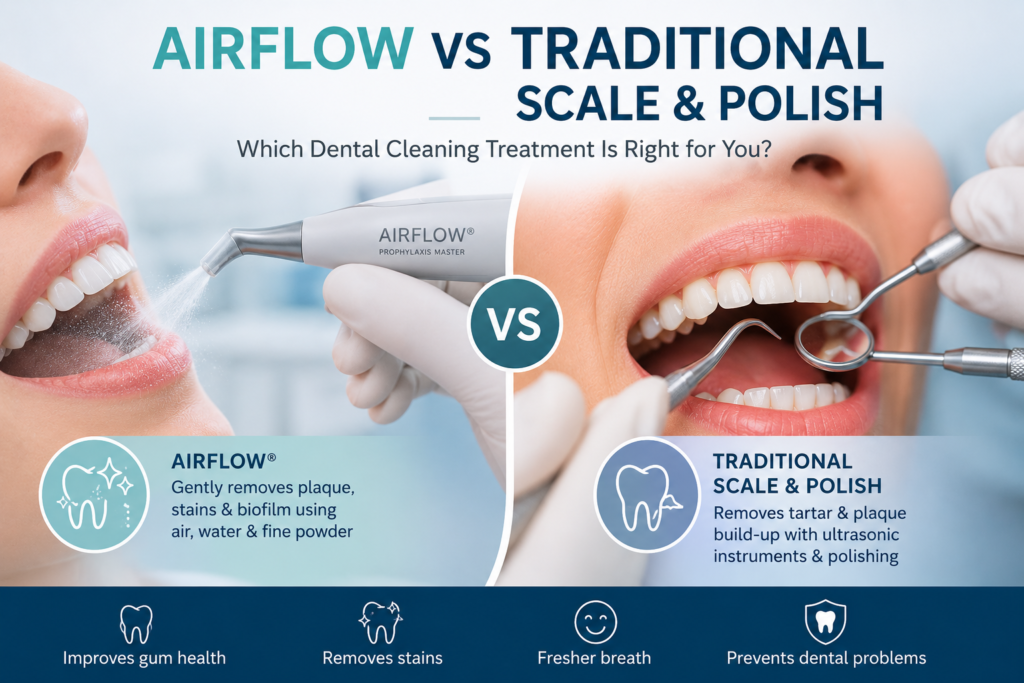
First, your dentist or hygienist removes hardened plaque, known as tartar or calculus, from around the teeth and beneath the gum line. This is usually performed using ultrasonic instruments, hand scalers or a combination of both.
Once the tartar has been removed, the teeth are polished using a soft rotating brush and a specially formulated polishing paste. This helps smooth the tooth surfaces and remove some superficial staining, leaving your teeth feeling clean and refreshed.
A traditional scale and polish is particularly beneficial for patients who have:
- Tartar build-up
- Early gum disease (gingivitis)
- Mild to moderate periodontal disease
- Plaque accumulation around the gum line
- Areas that are difficult to clean at home
Because tartar is firmly attached to the tooth surface, it cannot be removed by brushing alone. Regular professional scaling is therefore an essential part of maintaining healthy gums.
What Is AirFlow Dental Cleaning?
AirFlow is a more modern approach to professional dental cleaning.
Rather than relying solely on traditional polishing, AirFlow uses a controlled stream of warm water, compressed air and a very fine powder to gently remove plaque, soft biofilm and surface stains from the teeth.
First, your dentist or hygienist removes hardened plaque, known as tartar or calculus, from around the teeth and beneath the gum line. This is usually performed using ultrasonic instruments, hand scalers or a combination of both.
The powder is extremely fine, allowing it to clean areas that are often difficult to reach using conventional polishing methods.
AirFlow dental cleaning is particularly effective at removing staining caused by:
- Coffee
- Tea
- Red wine
- Smoking
- Certain foods
- Everyday staining from normal life
Because the treatment is gentle, many patients find AirFlow more comfortable than conventional polishing.
It also reaches around braces, dental implants, crowns and bridges more effectively than traditional polishing alone.
AirFlow Dental Cleaning vs Traditional Scale & Polish: What’s the Difference?
Although both treatments improve oral health, they are designed to address slightly different problems.
| Traditional Scale & Polish | AirFlow Dental Cleaning |
| Removes hardened tartar | Removes soft plaque and biofilm |
| Removes some staining | Excellent stain removal |
| Ideal for gum disease | Excellent for cosmetic cleaning |
| Uses ultrasonic and hand instruments | Uses warm water, air and fine powder |
| Removes calculus | Does not remove heavy tartar alone |
| May feel firmer for some patients | Usually very gentle and comfortable |
One treatment is not necessarily better than the other. Instead, they often work best together.
Which Treatment Gives Better Results?
The answer depends on what you’re hoping to achieve.
If your main concern is gum health, removing tartar is essential. Since AirFlow dental cleaning alone cannot remove heavy calculus deposits, a traditional scale is often required.
However, if your teeth are generally healthy and you’re looking to remove staining from coffee, tea or smoking, AirFlow dental cleaning can produce impressive cosmetic results while remaining gentle on your teeth and gums.
Many patients notice that their teeth appear cleaner, smoother and naturally brighter after AirFlow treatment, even though the treatment does not whiten the teeth in the same way as professional whitening.
Can AirFlow Dental Cleaning Replace a Traditional Scale & Polish?
Not always. If there is significant tartar around your teeth, your hygienist will normally remove this first using conventional scaling.
Once the hard deposits have been removed, AirFlow dental cleaning can then be used to eliminate remaining plaque and staining while polishing the teeth to a very smooth finish.
This combined approach provides excellent clinical and cosmetic results.
Is AirFlow Dental Cleaning More Comfortable?
Many patients believe so.
Because AirFlow dental cleaning uses a gentle stream of warm water and fine powder rather than rubbing the teeth with a polishing paste, it is often described as feeling lighter and more comfortable.
Patients with:
- Sensitive teeth
- Dental implants
- Orthodontic braces
- Cosmetic dental work
often find AirFlow particularly pleasant.
How Long Does the Treatment Take?
Most hygiene appointments last between 30 and 60 minutes, depending on the amount of plaque and tartar present.
Your appointment may include:
- Oral health assessment
- Scale and polish
- AirFlow cleaning
- Personalised oral hygiene advice
- Gum health assessment
Your hygienist/dentist will explain each step before beginning treatment.
How Often Should You Have Professional Dental Cleaning?
For most adults, professional dental hygiene every six months is recommended.
However, patients with gum disease, dental implants or heavy plaque build-up may benefit from more frequent visits every three to four months.
Regular maintenance helps prevent problems developing and reduces the need for more extensive treatment in the future.
Frequently Asked Questions
Does AirFlow whiten teeth?
AirFlow removes external stains, making teeth appear cleaner and brighter. However, it does not change the natural shade of your teeth like professional teeth whitening treatments.
Is AirFlow suitable for sensitive teeth?
Yes. Many patients with sensitive teeth find AirFlow more comfortable than conventional polishing because it uses warm water and fine powder.
Can AirFlow remove tartar?
No. Heavy tartar usually requires traditional scaling using ultrasonic or hand instruments before AirFlow is performed.
Is AirFlow safe for dental implants?
Yes. AirFlow is widely used around dental implants because it effectively removes plaque and biofilm while being gentle on implant surfaces.
Does AirFlow damage enamel?
No. When performed by trained dental professionals using the correct technique, AirFlow is considered a safe and minimally invasive cleaning method.
Can smokers benefit from AirFlow?
Absolutely. AirFlow is particularly effective at removing many of the surface stains commonly associated with smoking, helping restore a cleaner appearance.
Is AirFlow suitable for children?
Depending on the child’s age and oral health, AirFlow may be appropriate. Your dentist or hygienist will advise whether it is suitable.
Can I eat straight after treatment?
In most cases, yes. If a fluoride treatment has been applied, your dental professional may advise waiting for a short period before eating or drinking.
Which Professional Cleaning Option Is Best for You?
Both AirFlow and a traditional scale and polish play an important role in maintaining excellent oral health. Rather than competing treatments, they are often complementary, with each offering unique benefits depending on your individual needs.
If your priority is removing hardened tartar and improving gum health, a traditional scale remains essential. If you’d like to remove stubborn surface stains and enjoy a gentler, more comfortable cleaning experience, AirFlow can provide outstanding results. For many patients, combining both treatments delivers the healthiest gums, the cleanest teeth and the brightest natural smile.
At Medical Dental Spa, we tailor every hygiene appointment to your individual oral health. Whether you need routine maintenance, stain removal or treatment for gum disease, our experienced team will recommend the most appropriate approach to help keep your smile healthy and looking its best.