Teeth Retainers: Why They Matter After Braces or Clear Aligners
Finishing orthodontic treatment is an exciting moment. After months or sometimes years of wearing braces or clear aligners, your teeth are finally in their new positions. But removing your braces or finishing your last set of aligners does not mean the treatment is completely over.
The next stage is retention – and it is one of the most important parts of keeping your teeth straight.
Teeth are not permanently locked into position after orthodontic treatment. The bone and tissues surrounding them need time to adapt, and teeth can continue to move throughout life. Without appropriate retention, some of the movement achieved with braces or aligners can gradually be lost. This is known as orthodontic relapse.
There are several ways of retaining teeth, and there is no single retainer that is automatically best for everybody.
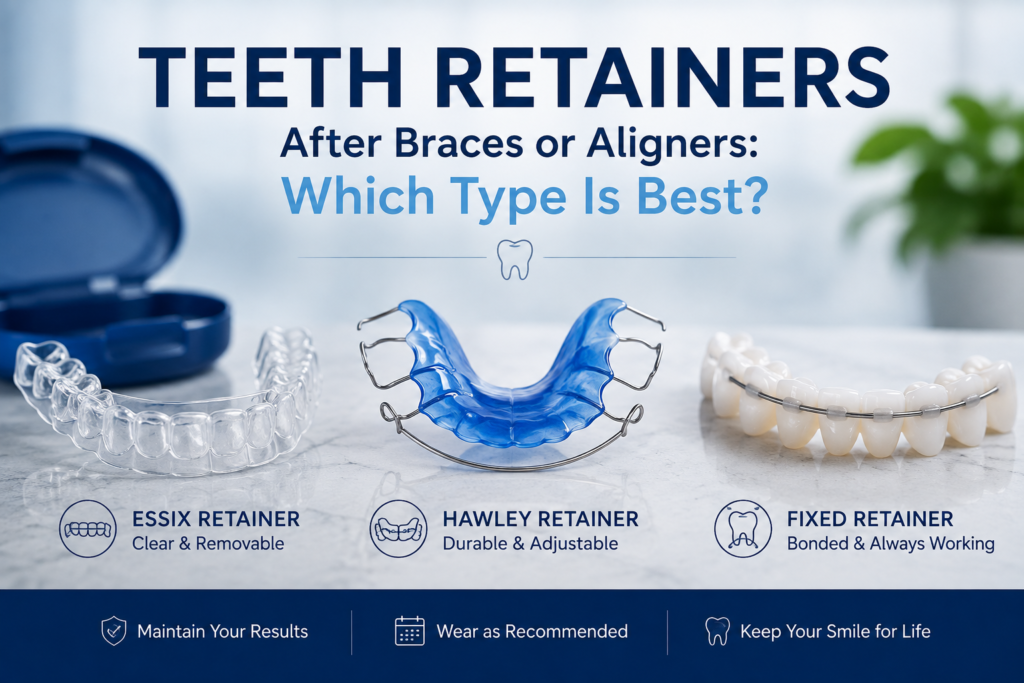
The three types you are most likely to encounter are:
- Clear plastic (Essix or vacuum-formed) retainers
- Hawley retainers
- Fixed or bonded retainers
Each has advantages and disadvantages, and in some cases a dentist or orthodontist may recommend using more than one type.
First: What Is the Difference Between Braces, Aligners and Retainers?
These terms are sometimes used interchangeably, but they do different jobs.
Dental Braces
Fixed braces use brackets attached to the teeth and wires to gradually move the teeth into their planned positions. They can make very precise tooth movements and remain one of the most established forms of orthodontic treatment. Treatment with fixed appliances is normally followed by retention
Clear Aligners
Clear aligners are a series of custom-made transparent trays. Each aligner applies controlled forces to gradually move the teeth towards their planned positions. Unlike fixed braces, aligners can be removed for eating, drinking and cleaning.
Teeth Retainers
Retainers are different. A retainer is generally not intended to straighten your teeth. Its primary purpose is to help maintain the position achieved after orthodontic treatment.
Think of it this way: Braces or aligners move your teeth. Retainers help keep them there.
That distinction is important because patients sometimes stop wearing their retainer when their teeth look straight, assuming the job is finished. Unfortunately, teeth can move again.
Why Do Teeth Move After Orthodontic Treatment?
There are several reasons.
After orthodontic treatment, the tissues and bone surrounding the roots need time to adapt to the new tooth positions. There is a particularly significant risk of relapse during the early months after treatment. But tooth movement is not exclusively an early problem. Our teeth can naturally change position as we age, which means some movement may occur years after orthodontic treatment has finished
This is why modern orthodontic advice generally favours long-term retention rather than assuming that retainers can simply be abandoned after a few months.
What Is an Essix Retainer?
An Essix-style retainer – more generally called a clear or vacuum-formed retainer – is a thin transparent plastic appliance moulded closely around your teeth.
It looks somewhat similar to a clear aligner, which is why patients sometimes confuse the two. The difference is their purpose. A clear aligner is designed to move teeth, whereas a clear retainer is designed primarily to hold them in position.
Advantages of Clear Retainers
Clear retainers are popular for several reasons. They are discreet, relatively lightweight and closely follow the shape of your teeth. Most people adapt to them quickly, and because they are removable, you can brush and floss normally. They are also aesthetically appealing because they are much less noticeable than a traditional Hawley retainer.
Disadvantages of Clear Retainers
Clear retainers are not indestructible. The plastic can gradually wear, distort, crack or become discoloured, meaning replacement may eventually be necessary. They are also removable, which creates perhaps their biggest weakness: they only work when you actually wear them.
A perfectly made retainer sitting in its storage box cannot prevent your teeth from moving. They can also be lost surprisingly easily – particularly when wrapped in a tissue or napkin during meals.
What Is a Hawley Retainer?
The Hawley retainer is the traditional removable orthodontic retainer that many people recognise. It normally consists of a rigid acrylic section that sits against the palate or behind the lower teeth, together with a metal wire running across the front teeth. It may look more old-fashioned than a clear retainer, but that does not make it obsolete.
Advantages of Hawley Retainers
One of the major advantages is durability. Hawley retainers tend to be robust and can often tolerate long-term use well. They are removable, so normal brushing and flossing remain straightforward when the retainer is taken out. Depending on the design and clinical situation, adjustments may also be possible.
Disadvantages of Hawley Retainers
The obvious disadvantage is appearance. The metal wire across the front teeth is visible, whereas an Essix retainer is much more discreet. The acrylic section can also feel bulky initially, particularly in an upper retainer. Some patients notice temporary changes to their speech when they first start wearing one, although this generally improves as they become accustomed to it.
And, just like an Essix retainer, it relies on the patient remembering to wear it.
What Is a Fixed or Bonded Retainer?
A fixed retainer takes a completely different approach. Rather than being removed and replaced by the patient, a thin wire is bonded to the inside surfaces of the teeth – commonly behind the front teeth. From the front, it is normally virtually invisible.
Advantages of a Fixed Retainer
Its biggest advantage is simple: you don’t have to remember to put it in every night.
It remains attached to the teeth continuously, providing retention day and night. This can be particularly useful in areas where maintaining tooth position is considered important or where the risk of relapse is higher.
Disadvantages of a Fixed Retainer
Fixed does not mean maintenance-free. Plaque and calculus can accumulate around the wire and bonding material, so cleaning requires considerably more attention than with a removable retainer. Flossing around the wire can also be more difficult. The wire or one of its bonded attachments can occasionally become loose or break. This is particularly important because the failure may not always be immediately obvious.
If part of a bonded retainer becomes detached, a tooth may begin moving while the rest of the retainer still appears to be in place. For this reason, bonded retainers should be checked regularly and patients should contact their dentist or orthodontic provider if they notice anything loose or unusual.
Essix vs Hawley vs Fixed Retainer
There is no universally superior option.
| Clear / Essix | Hawley | Fixed / Bonded | |
| Visibility | Very discreet | Metal wire visible | Hidden behind teeth |
| Removable | Yes | Yes | No |
| Patient needs to remember it | Yes | Yes | No |
| Durability | Moderate | Generally good | Can last a long time but bonding/wire can fail |
| Cleaning teeth | Easy when removed | Easy when removed | More difficult around wire |
| Cleaning retainer | Straightforward | Straightforward | Cleaned while attached |
| Can be lost | Yes | Yes | No |
| May need replacement | Yes | Yes | Yes/repair |
| Speech adjustment | Usually minor | Can initially affect speech | Usually minimal |
The right choice therefore depends on the individual patient rather than simply choosing whichever retainer looks best.
Can You Have Both a Fixed and Removable Retainer?
Yes. This can actually be a very useful combination. A fixed retainer can provide continuous retention behind the front teeth, while a removable retainer worn at night can retain a broader group of teeth. The British Orthodontic Society notes that some patients may be advised to use more than one type of retainer to reduce the chance of relapse.
Having a fixed retainer therefore does not necessarily mean you will never need a removable one. Your dentist or orthodontic provider should recommend the retention strategy appropriate to your particular case.
Your dentist or orthodontic provider should recommend the retention strategy appropriate to your particular case.
How Long Should I Wear My Retainer?
This is where we need to be careful with blanket statements such as: “Wear it for six months and you’re finished.”
There isn’t one universal schedule suitable for every patient. Different orthodontic departments use different protocols. For example, Nottingham University Hospitals describes nightly wear during the first year followed by reduced but indefinite wear, while other NHS services use different schedules. The common theme is that long-term retention is important if you want to maintain tooth alignment.
Your own dentist or orthodontic provider’s instructions should therefore take priority. In practical terms: If you want your teeth to stay straight long-term, expect retention itself to be long-term.
What Happens If I Stop Wearing My Retainer?
Your teeth may move. How much they move and how quickly varies considerably between people. Some patients notice very little change initially. Others may find that their removable retainer already feels noticeably tighter after a period without wearing it.
The longer a retainer is left out, the greater the possibility that it may eventually stop fitting properly. Do not try to force a retainer over teeth if it clearly no longer fits.
If your retainer has become uncomfortable, no longer seats correctly or your teeth appear to have moved, arrange an assessment.
How Should I Clean a Clear Retainer?
Clear retainers should be cleaned regularly because plaque, saliva and debris accumulate on them. A simple routine is usually sufficient: Rinse the retainer with cool or lukewarm water and gently clean it using a separate soft toothbrush and suitable liquid soap or the cleaning product recommended by your dental professional.
Avoid very hot or boiling water. Heat can distort the plastic, and once its shape changes it may no longer fit your teeth correctly.
Several NHS orthodontic departments specifically advise against toothpaste for clear retainers because abrasive toothpaste can scratch the plastic and make it cloudy.
How Should I Clean a Hawley Retainer?
Hawley retainers should also be cleaned regularly. Gently brush the acrylic and wire surfaces using cool water and an appropriate cleaning product. Take care around the metal components rather than aggressively bending or scrubbing them.
When you’re not wearing the retainer, keep it in a protective retainer case rather than wrapping it in a tissue.
How Do I Clean Around a Fixed Retainer?
Fixed retainers require particularly good oral hygiene. Brush carefully around the back of the teeth and around the bonded wire. Depending on the position of the retainer, interdental brushes, floss threaders or other interdental cleaning aids may make cleaning underneath and around the wire easier.
This matters because plaque left around a bonded retainer can contribute to gum inflammation and other oral health problems.
Regular dental examinations and hygiene appointments also provide an opportunity to check that the retainer remains secure.
Can I Eat While Wearing My Removable Retainer?
Generally, removable retainers should be taken out for meals unless you have specifically been instructed otherwise. The British Orthodontic Society advises that vacuum-formed retainers should not be worn while eating or drinking, while NHS guidance commonly permits plain water while they are being worn.
Once removed, put the retainer straight into its case. Not on the table. Not in your pocket. And definitely not wrapped in a napkin.
A surprising number of removable retainers disappear into bins that way.
What If My Retainer Breaks?
Don’t simply wait until your next routine appointment. If a removable retainer cracks, breaks or stops fitting, contact your dental or orthodontic provider.
The same applies to a fixed retainer.
If you feel that the wire has detached from one of the teeth, feels loose or has broken, arrange an assessment. Teeth may begin to move if the retainer is no longer functioning correctly.
How Often Should I Replace My Retainer?
There is no meaningful universal replacement date.
A retainer should be replaced when its condition or fit means it can no longer reliably do its job.
That may include:
- cracks or splits
- significant wear
- distortion
- a poor fit
- damaged wires
- broken bonding
- or changes in your teeth that mean the existing retainer no longer fits appropriately
Some patients will need replacements considerably sooner than others.
Which Retainer Is Best?
This is probably the most important question and the most honest answer is:
it depends.
If appearance and simplicity are your priorities, a clear retainer may be attractive. If you want a robust removable appliance, a Hawley retainer may have advantages. If you know that remembering to wear a removable retainer will be difficult, a bonded retainer removes that particular problem – but replaces it with the need for meticulous cleaning and regular monitoring.
And for some patients, the best solution may be a combination of fixed and removable retention. Rather than asking which retainer is “the best”, a better question is: Which retention strategy is most appropriate for my teeth, my original orthodontic problem and my lifestyle?
The Part of Orthodontic Treatment That Is Easy to Underestimate
Patients understandably concentrate on getting their teeth straight. But keeping them straight deserves just as much attention.
Braces and clear aligners can produce impressive changes, but those results still need protecting afterwards. A retainer may be far less exciting than seeing your new smile for the first time, but it plays an essential role in maintaining that result.
If you’ve recently completed orthodontic treatment, have an old retainer that no longer fits, have noticed your teeth beginning to move, or are unsure whether your current retainer is still doing its job, it is worth having it assessed rather than waiting for the movement to become more noticeable.
At Medical Dental Spa in West Hampstead, we can assess your teeth and existing retainers and discuss the appropriate options for maintaining your smile.
Have a question about your retainer? Contact our team or send us a WhatsApp message and we’ll be happy to help.