What Is No Drill Dentistry?
No Drill Dentistry is a minimally invasive approach that prioritises early detection, preventive treatment, and preserving healthy tooth structure – often reducing or eliminating the need for drilling altogether.
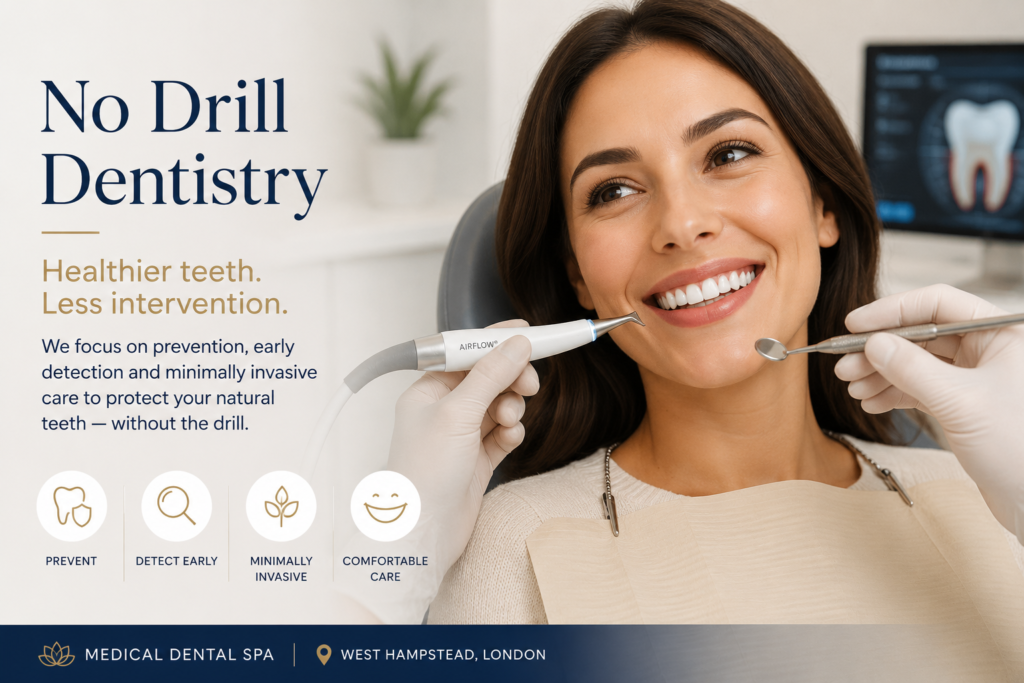
At Medical Dental Spa in West Hampstead, we use early diagnosis and minimally invasive techniques to protect your natural teeth – with less anxiety and more confidence.
It does not mean drilling is never used. It means every clinical decision is guided by one principle: do as little as necessary to achieve the best long-term outcome for your tooth.
- Identifying problems at the earliest possible stage
- Halting or reversing damage before it progresses
- Protecting natural enamel wherever possible
- Choosing the least invasive treatment option clinically appropriate for your situation
Why Patients Choose a Fear-Free Approach
It feels calmer, You understand what is happening and what your options are before any decision is made. You understand what is happening and what your options are before any decision is made.
It feels proportionate, Treatment is scaled to the actual problem – nothing is done that is not clinically necessary. Treatment is scaled to the actual problem – nothing is done that is not clinically necessary.
It feels reassuring, You are guided through the next step at your own pace, not simply handed a list of problems.
Early Warning Signs of Dental Problems You Should Never Ignore
A tooth does not need to hurt to need attention.
Pain is a late signal. By the time a tooth becomes painful, the underlying problem has often been developing for months or years. Early signs that benefit from prompt attention include:
| Early Sign | What It Means | Why It Matters |
|---|---|---|
| White spot lesions | First visible sign of enamel demineralisation | Reversible at this stage with remineralising treatment |
| Plaque biofilm | Bacterial layer driving decay and gum disease | Removable with AirFlow before damage occurs |
| Early gum inflammation | Redness, swelling, bleeding on brushing | Fully reversible early; progressive if untreated |
| Dry mouth | Often medication-related; raises decay risk significantly | Manageable with the right preventive plan |
| Tooth wear & erosion | Linked to diet, reflux, or sleep habits | Protective measures effective when caught early |
What No Drill Dentistry Looks Like in Practice
No Drill Dentistry focuses on preventing, detecting and treating dental problems as early as possible, often without the need for traditional drilling. By combining advanced diagnostic technology, preventive care and minimally invasive treatments, we can help protect your natural teeth while making your dental experience more comfortable. Here’s what modern no drill dentistry looks like in everyday practice and how it can benefit your long-term oral health.
AirFlow and Advanced Hygiene Therapy
Biofilm – the bacterial layer that drives decay and gum disease – can be removed gently and effectively using AirFlow technology. Often more comfortable than traditional scaling, and reaches areas conventional instruments miss.
Early Enamel Intervention
When enamel changes are detected at a white-spot stage, we apply remineralising treatments to stabilise or reverse the damage. No drilling required at this stage.
Minimally Invasive Restorations
Where a restoration is clinically necessary, we use the most conservative preparation possible – removing only damaged tissue and preserving as much healthy tooth structure as can safely remain.
Personalised Prevention Planning
Your risk assessment considers medical history, medication use, diet, dry mouth, oral hygiene routine, and lifestyle — so prevention is genuinely tailored rather than generic.
Frequently Asked Questions
We understand that every patient has questions about modern dental care. Whether you’re curious about No Drill Dentistry, wondering if it’s suitable for you or your family, or simply want to understand your treatment options, we’ve answered some of the most frequently asked questions below to help you make informed decisions about your oral health.
Does no drill dentistry mean no fillings?
Not necessarily. If decay has progressed beyond the enamel into dentine, a restoration may still be needed. No Drill Dentistry means we do everything possible to catch problems before they reach that stage – and use the most conservative preparation if treatment is required.
Is this approach suitable for nervous patients?
Yes. Fear-free care is central to how we practise. Nervous patients often benefit most from this approach because the combination of clear communication, conservative treatment, and early intervention reduces both the clinical complexity and the emotional difficulty of appointments.
What if I have not been to a dentist in several years?
This is more common than you might think. We assess your current oral health without judgement, explain what we find, and propose a plan focused on stabilising and improving — not on highlighting everything that has gone wrong.
Can children benefit from no drill dentistry?
Yes. Preventive care and early enamel intervention are particularly valuable for children, when establishing good habits and protecting developing teeth has long-term impact on their adult dentition.
When is drilling still necessary?
Advanced decay, structural breakdown, or a tooth that has already been root-treated may still require conventional intervention. What changes with a minimally invasive approach is the threshold at which drilling becomes necessary. The earlier you come in, the more choices remain available.
Our Approach at Medical Dental Spa
Prevention first – most dental problems are preventable with early intervention and the right daily habits.
Early diagnosis – finding changes when treatment can still be simple and conservative.
Minimally invasive care – treating only what is necessary, preserving everything that can safely remain.
Clear, calm communication – so you always know what is happening, what your options are, and what to expect.
Who Is This Approach For?
- Nervous patients
- Returning after a long gap
- Early tooth wear or erosion
- Dry mouth
- Repeated decay or gum problems
- Children & teenagers
- Gentle dentist NW6 / West Hampstead
Book a Fear-Free Assessment in West Hampstead
Whether you are coming in for the first time or returning after a long absence, we will assess your oral health without judgement and guide you through a plan that makes sense for you.